
Platform · Reporting
Reporting and reconciliation - stop matching spreadsheets
LekkaPay reporting is the back office behind every payment: settlement statements that match what actually arrived in your bank account, every fee itemised, decline analytics, and reconciliation exports your finance system can ingest. It works identically whether you process under a LekkaPay merchant account or through the gateway on your own MID - one back office, both models.
LAST UPDATED ·
- Settlement statements Every deposit explained line by line - transactions in, fees out, reserve movements shown, nothing blended.
- Itemised fees Every fee visible against the transaction that incurred it. If you cannot see a fee, you cannot question it.
- Decline analytics What was declined, where and why - the raw material for recovering lost conversion.
- Reconciliation exports Structured exports your accounting software and your accountant can work with directly.
- One back office, both models Merchant accounts and your-own-MID gateway processing report identically - graduating changes nothing.
How it works
How it works
-
Every event is recorded once
Payments, refunds, chargebacks and fees land in a single ledger view as they happen - across every payment method.
-
Settlements match themselves
Each settlement statement reconciles automatically to the transactions inside it, so the deposit in your bank account is explained line by line.
-
You export or hand over
Reconciliation exports for your finance system, and role-based access so your accountant sees the reports without touching operations.
Stop matching spreadsheets
The quiet cost of taking payments is the month-end ritual: a bank statement in one window, a sales export in another, and a finance person matching rows until they agree. LekkaPay's back office exists to delete that ritual. Every payment, refund, chargeback and fee is recorded in one ledger view as it happens, and every settlement statement reconciles automatically to the transactions inside it - so the deposit that lands in your bank account arrives pre-explained, line by line. Your finance team reviews exceptions; the software does the matching.
What does fee transparency actually mean?
It means every fee is itemised against the transaction that incurred it, and settlement statements separate principal from fees from reserve movements - no blended lump sums to reverse-engineer at quarter-end. Payments pricing has a reputation for burying costs in netting, and the defence against that is not a promise but a report format: if you can see every fee, you can question every fee. That is the standard LekkaPay statements are built to, because we would rather win on being checkable than on being vague - and it holds for the awkward lines too, including chargebacks, refunds and rolling reserve movements on merchant accounts.
What can decline analytics tell you?
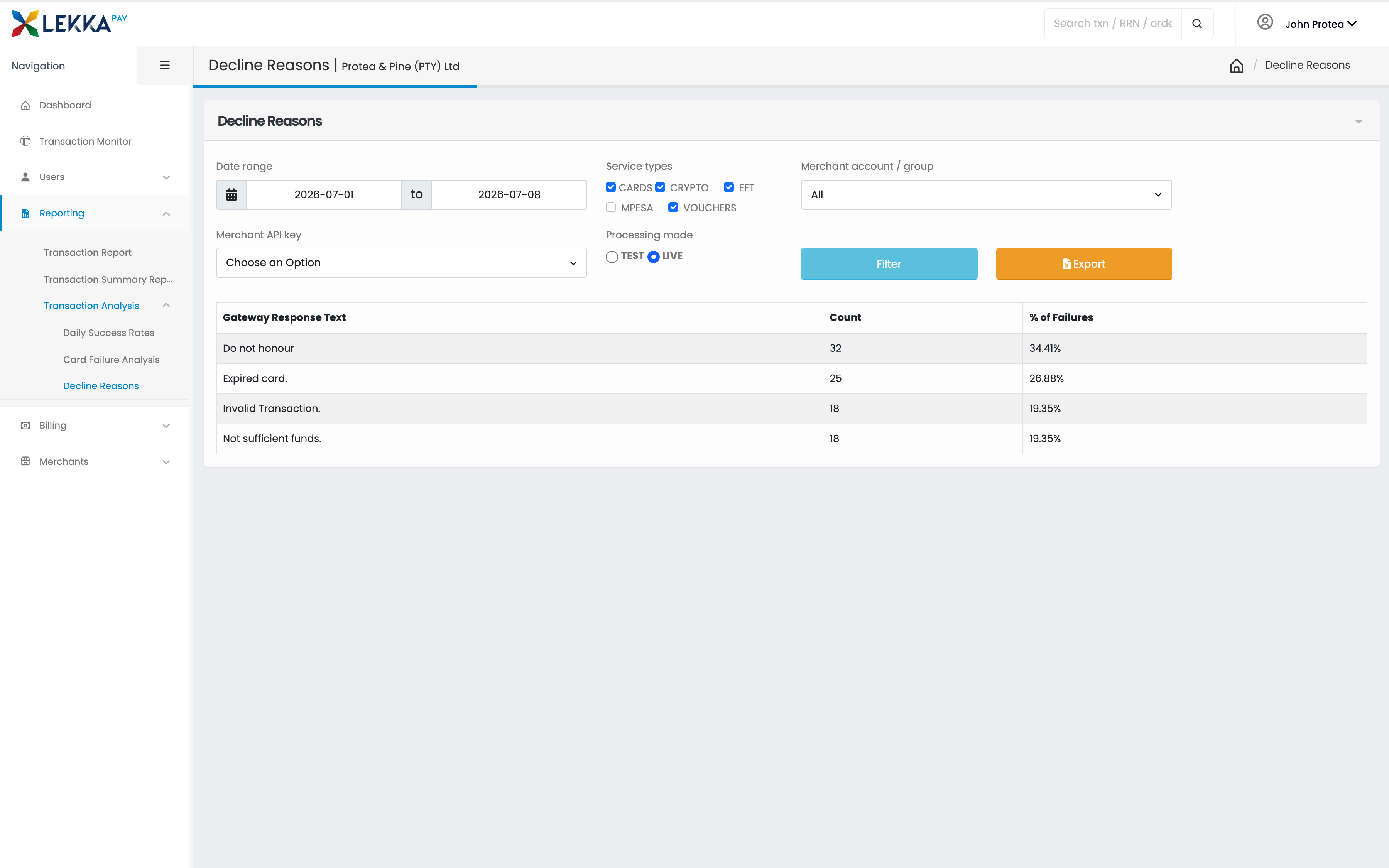
Declines are the invisible leak in most merchants' numbers - a payment that fails is rarely retried, and few merchants can say what their decline rate even is. LekkaPay's decline analytics show what was refused, where and why: issuer declines, risk-engine blocks and authentication failures, broken down so patterns surface. A spike on one card type, a rule blocking more than it should, a method quietly underperforming on mobile - each is recoverable revenue once it is visible, and visible is the point.
One back office, both models
Reporting works identically whether you process under a LekkaPay merchant account or through the gateway on your own MID - the same statements, the same exports, the same analytics. That symmetry is deliberate: merchants who graduate from facilitation to direct acquiring keep their reporting history and their finance team's routines intact, and accountants with clients on both models work in one familiar interface. Whichever model your business is in this year, month-end looks the same.
- commercial models - merchant accounts and your-own-MID gateway - served by one identical reporting back office
- 2
- LekkaPay platform capability, 2026
The back office
What will your finance team actually see?
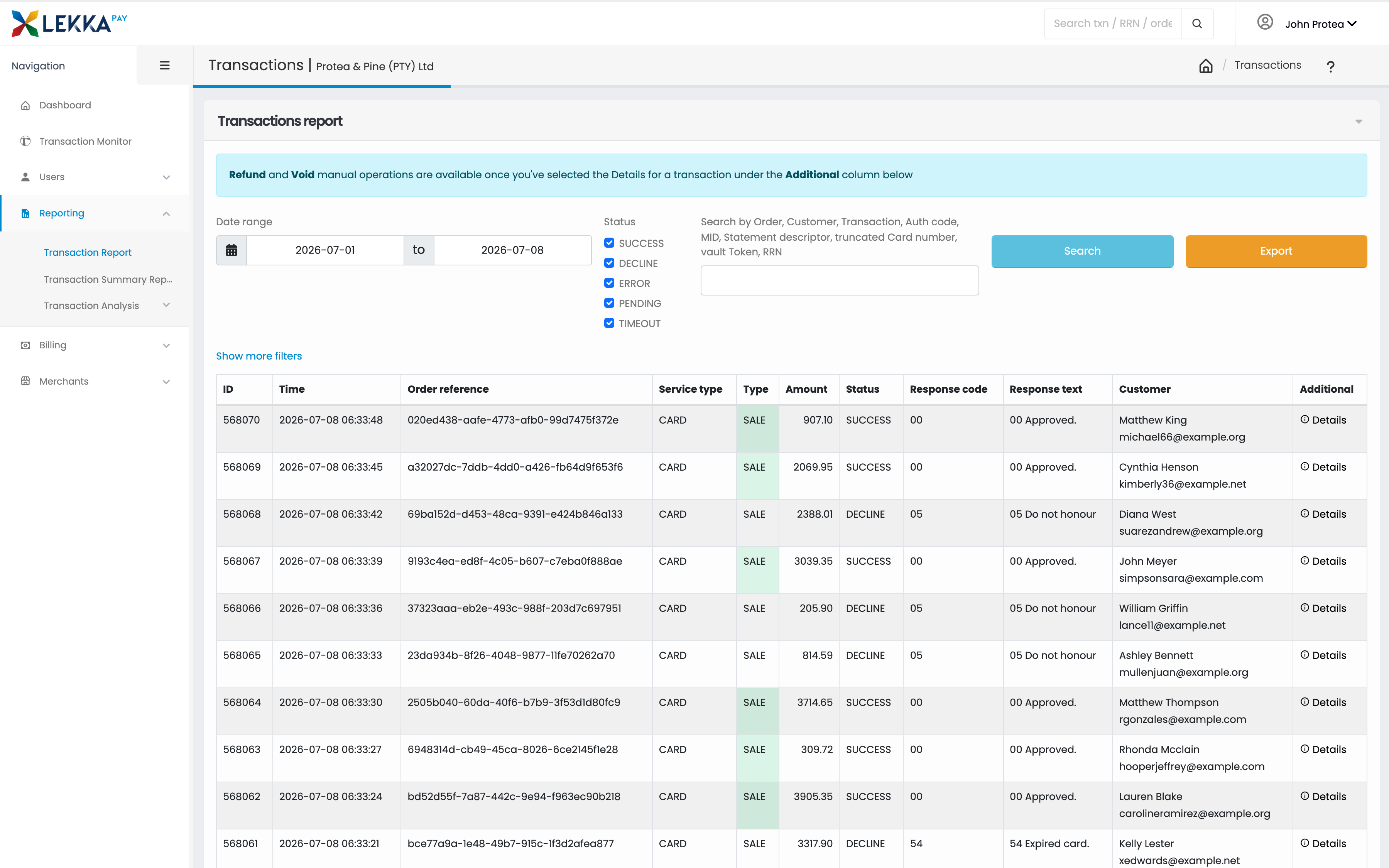
Real views from the LekkaPay back office - decline analytics grouped by reason, and a transaction report you filter and export.
FAQ
Your questions, answered
What reports does LekkaPay provide?
Settlement statements that explain every deposit line by line, transaction reporting across every payment method, itemised fee reporting, decline analytics showing what was refused and why, and reconciliation exports for your finance system. All of it lives in one back office, whichever LekkaPay model you process under.
Can I export my data?
Yes - reconciliation and transaction data export in structured formats your accounting software and your accountant can work with directly. Your data is yours: exports are a standard capability, not a favour to request.
How does reconciliation work?
Every settlement statement reconciles automatically to the transactions inside it: the deposit that lands in your bank account is explained line by line - payments in, refunds and fees out, reserve movements shown. Instead of matching a bank statement against a sales export by hand, your finance team reviews exceptions and moves on.
Can my accountant get access?
Yes - access is role-based, so you can give your accountant or bookkeeper their own login with visibility of statements, reports and exports without exposing operational controls like refunds or configuration. No more forwarding PDFs at month-end.
Is fee reporting itemised?
Fully. Every fee appears against the transaction that incurred it, and settlement statements show fees separately from principal - no blended lump sums to reverse-engineer. If a number on your statement cannot be traced to its source, we consider that a defect, not a detail.

One platform, two models.
Start on LekkaPay merchant accounts or bring your own MID - same API, same back office, no re-integration.